
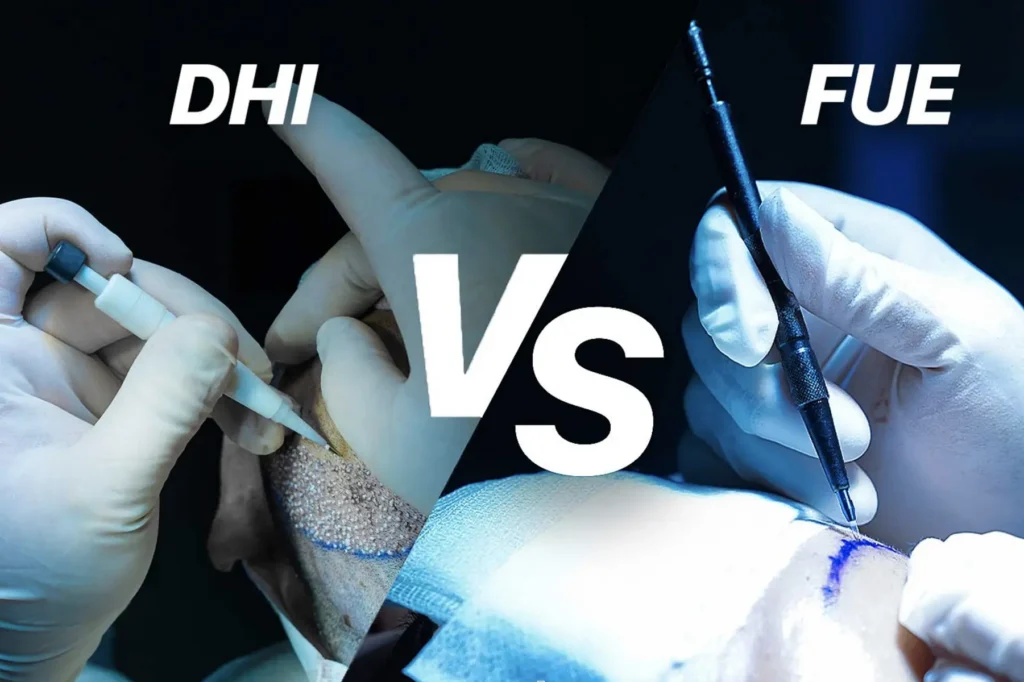
At first, it sounds like they are two completely separate treatments. That is usually why people get confused. One clinic says FUE is the best option. Another talks about DHI like it is something far more advanced. After a while, it becomes hard to tell what is real and what is just marketing.
The truth is a bit simpler than that.
When people compare DHI vs FUE, they are usually trying to understand which method will give them the most natural result, the easiest recovery, and the best overall experience. Those are fair questions. But before choosing one, it helps to understand what each method actually involves and where the real differences begin.
What Is FUE?
FUE hair transplant stands for Follicular Unit Extraction.
This method involves removing individual hair follicles from the donor area, usually at the back or sides of the scalp, and then transplanting them into thinning or balding areas. It is one of the most widely used techniques in modern hair restoration, and for good reason. It is effective, well known, and suitable for many different types of hair loss.
With FUE, the grafts are extracted one by one. After that, the recipient area is prepared and the follicles are placed carefully into those areas.
One reason so many patients start with FUE is that it has a strong track record and works well for hairline work, crown restoration, and broader coverage. During a personalised consultation, it is often one of the first options patients ask about because it is familiar and widely recommended.
What Is DHI?
DHI stands for direct hair implantation.
This is where people often get mixed up. DHI is not usually a completely separate world from FUE. In many cases, the follicles are still extracted using the FUE method. The main difference is in how the follicles are implanted.
With DHI, the grafts are often placed using a special implanter pen, which allows the practitioner to implant the follicles directly into the scalp without first making all the channels in the same way as traditional FUE placement.
That is why many experts describe DHI as a variation of FUE rather than something totally separate. The extraction part is often very similar. The implantation part is where the process changes.
This one detail is a big reason why the DHI vs FUE conversation can feel confusing online. Some clinics present them like opposites, but in reality they are closely related.
The Main Difference in Simple Words
If you want the easiest way to understand DHI vs FUE, here it is.
With FUE, grafts are extracted individually and then implanted after the recipient area has been prepared.
With DHI, grafts are also usually extracted individually, but they are implanted using a pen-like tool that can allow for more direct placement.
So the real difference is not just extraction. It is more about the implantation technique and how the medical team approaches graft placement.
That difference can affect precision, shaving requirements, timing, and in some cases the type of patient each method suits best.
Does DHI Give Better Results?
This is one of the first questions people ask, and honestly, it is not as black and white as many websites make it seem.
A lot of patients assume DHI must be better because it sounds more specialised. But natural-looking results depend on much more than the label of the technique. Hairline design, graft placement, angle, density planning, and the experience of the team matter far more than flashy wording.
A well-done FUE hair transplant can look excellent. A well-done DHI procedure can also look excellent. The better question is not which one sounds more premium. The better question is which one suits your hair loss pattern, your donor area, and your expectations.
That is why it helps to look at real success stories instead of judging by names alone. Results tell you far more than branding ever will.
What About Shaving?
This is where DHI gets a lot of attention.
Some patients are drawn to DHI because it is often linked with the idea of an unshaven hair transplant or at least less visible shaving in certain cases. That can make it appealing for people who want a more discreet experience, especially if they do not want the procedure to be obvious right away.
That said, not every DHI case is fully unshaven. It depends on the number of grafts needed, the area being treated, and the clinic’s approach. In some cases, partial shaving may still be needed.
FUE can also involve shaving, especially when a larger number of grafts are required. For some patients this is not an issue at all. For others, it matters a lot.
So if discretion is high on your priority list, this is something worth discussing early rather than assuming one method always avoids shaving.
Recovery Time: Is One Easier Than the Other?
When comparing DHI vs FUE, recovery is another big concern.
The good news is that both are generally manageable. Neither one should feel mysterious or overwhelming when you understand what to expect. There will be healing, some redness, and a recovery phase where patience matters more than anything else.
In many cases, recovery between the two is quite similar because both involve transplanting follicles into the scalp. Some people feel DHI is a little gentler in certain cases, while others find there is not a dramatic difference at all.
What matters most is proper aftercare. Following instructions around washing, sleeping, exercise, and sun exposure can make a huge difference to the overall experience. That is why proper post-care support matters so much after any procedure.
Which One Is Better for Density?
This question comes up a lot, especially among people who are focused on filling in the hairline or getting a denser look in smaller areas.
DHI is often praised for precise placement, which can make it attractive for hairline work and detail-focused cases. Because the implantation is controlled in a slightly different way, some people feel more confident about using it in visible areas where angle and direction matter a lot.
FUE is also capable of producing strong density when planned properly. It is not fair to say FUE cannot create natural-looking fullness, because it absolutely can.
This is where a proper hair transplant technique comparison becomes more useful than bold claims. DHI may offer advantages in some cases, but FUE remains a proven and reliable option for many patients. Suitability matters more than hype.
Is DHI More Expensive?
In many cases, yes, DHI can be priced higher than standard FUE.
That usually comes down to how the procedure is positioned, the tools involved, and the amount of detailed implantation work required. But price should not be the only reason you lean one way or the other.
A more expensive technique is not automatically better for you. If your hair loss pattern, donor area, and goals are better suited to FUE, then paying more for DHI just because it sounds more advanced may not make much sense.
That is why it helps to look at the full process, the treatment plan, and even the pricing structure with a clear head rather than assuming higher cost means better outcome.
So Who Usually Suits FUE?
FUE is often a strong fit for people who want a proven treatment, need good overall coverage, and are comfortable with a standard transplant approach that has been used successfully for years.
It is also a good option for patients who want flexibility across different areas of hair loss, whether that is a receding hairline, thinning through the top, or work in the crown.
Because FUE hair transplant is so widely used, it is often the technique many patients end up choosing once they understand how versatile it can be.
So Who Usually Suits DHI?
DHI often appeals to people who are especially focused on precision, hairline detail, or a more discreet process. Patients who are interested in an unshaven hair transplant often ask about DHI first, although whether that is possible depends on the case.
It can also appeal to people who like the idea of direct implantation and the control that comes with it. But again, suitability matters more than the label. DHI is not automatically the right choice just because it sounds more advanced.
Final Thoughts
The biggest mistake people make when comparing DHI vs FUE is thinking one must be the clear winner and the other must be second best.
That is usually not how it works.
Both methods can produce natural, impressive results when they are done well. Both have their place. And both can be the right option depending on the person sitting in the chair.
If you are trying to decide between them, focus less on marketing language and more on what actually fits your hair, your goals, and your comfort level. That is usually where the best decision comes from.
FAQs
Is DHI better than FUE?
Not automatically. DHI vs FUE depends on your hair loss, goals, donor area, and whether precision or broader coverage matters more in your case.
Is DHI the same as direct hair implantation?
Yes. DHI stands for direct hair implantation, and it usually refers to the way grafts are implanted rather than a completely separate extraction method.
Can DHI be done as an unshaven hair transplant?
In some cases, yes. DHI is often linked with an unshaven hair transplant, but it depends on the number of grafts and the treatment area.
Does FUE hair transplant still give natural results?
Yes, absolutely. A well-planned FUE hair transplant can look very natural when the hairline, angle, and density are handled properly.
What matters most in a hair transplant technique comparison?
The key factors are your hair loss pattern, donor area, recovery expectations, and the skill of the team performing the procedure.
